· Alp Burak Çatakoğlu · 6 min read
What Is Renal Denervation and Who Is It For?
Renal denervation is a catheter-based treatment method that targets the sympathetic nerves around the renal vessels in hypertension that is difficult to control with medications. To whom it is applied, its risks and effects are in this guide.
Physician Approval: Prof. Dr. Alp Burak Çatakoğlu Last Update: 2026-02-05
What is renal denervation?
Short Answer: Renal denervation is the targeting of sympathetic nerves around the renal vessels with a catheter in hypertension that cannot be adequately controlled with medications. It may provide additional contribution to blood pressure control in suitable patients.
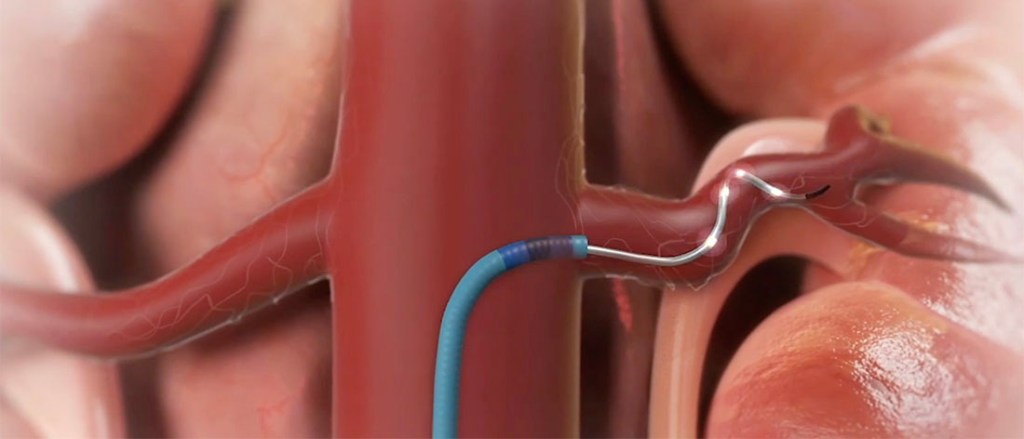
Renal denervation is a minimally invasive method used for the permanent treatment of hypertension, performed using a catheter and radiofrequency energy. By entering the vein in the groin, the veins feeding the kidneys are reached, and the nerve activity around the vein is partially blocked with radiofrequency from the tip of the catheter. In this way, a permanent decrease in blood pressure is achieved. It has been approved by the FDA and has been shown to be effective and safe in 10-year follow-up studies.
Who can undergo renal denervation?
- Resistant hypertension: Patients whose blood pressure is above 130/80 mm Hg despite the three recommended medications and the highest tolerance doses. These medications include: angiotensin-converting enzyme inhibitors (ACE inhibitors), angiotensin II receptor blockers, calcium channel blockers, thiazide diuretics, and beta blockers.
- Uncontrolled hypertension: Patients who cannot control hypertension despite lifestyle changes and antihypertensive medications. Patients who are intolerant to additional medications or who do not want to use additional medications can accept the renal nerve denervation procedure after a shared decision-making process.
- High cardiovascular risk: Patients with additional health conditions such as coronary artery disease, diabetes, previous transient ischemic attack/diabetes mellitus, or chronic kidney disease may be given priority. These are the patients for whom a reduction in blood pressure would provide the greatest benefit.
- Drug incompatibility: Renal denervation is a suitable method for patients who have drug-related side effects and who do not want to take medication due to the possibility of side effects.
For which patients is renal denervation not suitable?
Renal denervation (RDN) has not been adequately examined in some patient groups. Therefore, caution should be exercised when evaluating results for these groups:
- Patients with renal failure:
- SPYRAL studies excluded patients with eGFR less than 45 mL/min/1.73 m².
- RADIANCE studies excluded patients with eGFR below 40 mL/min/1.73 m².
- Data on these patients are generally limited to observational studies.
- Patients with a single kidney:
- RDN studies have not been performed in patients with a single functioning kidney.
- Those with kidney diseases:
- Patients with atrophic kidney, renal tumor, renal artery stent, or significant renal artery stenosis (due to atherosclerotic disease, calcified lesions, or fibromuscular dysplasia) are not considered suitable for RDN.
- Patients with polycystic kidney disease:
- A small study is ongoing on the safety and effectiveness of RDN in adult patients with polycystic kidney disease.
- Secondary hypertension:
- In patients who are candidates for RDN, secondary causes of hypertension should be evaluated. Treating secondary causes may correct the cause of hypertension.
There is not enough information about the effectiveness and safety of RDN administration in these groups and therefore, careful evaluation should be made before administering RDN in these patient groups.
What are the risks of renal denervation?
Clinical studies of the renal denervation procedure generally show that complications related to the procedure are very rare and are mostly related only to groin port problems. This shows how important it is to apply the best methods for femoral artery access and bleeding control. Currently, new technologies are being developed for wrist-based renal denervation methods.
How is renal denervation performed?
Renal denervation is performed in the angiography laboratory by entering from the groin. The groin area is numbed with local anesthesia. The patient is relieved with sedation and painkillers. Angiography images of the renal vessels are taken with materials similar to the catheters used in the angiography procedure. Then, a flexible, spiral catheter is advanced into the renal vein. Radiofrequency energy is given simultaneously for 60 seconds through 4 electrodes at the tip of the flexible catheter. After this procedure is performed several times in the same vein, the procedure is repeated in the other renal vein. The process is completed in approximately 30 minutes. The entrance in the groin is closed using a gel closure device or manual compression. The patient, who is followed up in a normal room, is discharged on the same day or the morning of the next day.
How much does blood pressure decrease with renal denervation?
Many studies conducted to date have observed a 10-20 mmHg decrease in systolic blood pressure (systolic blood pressure).
What are the chances of success with renal denervation?
Studies have shown that 80% or more patients respond after renal denervation. It was not effective in 10-20% of patients. In order for the treatment to be effective, it is important to carry out a detailed preliminary evaluation.
Is the renal denervation procedure FDA approved?
Medtronic Spyral system and ReCor Paradise system have FDA (Food and Drug Administration, USA) approvals. It is used in the USA and Europe.
How does the price of renal denervation vary?
Renal denervation price; It varies depending on the patient profile, the system to be used, the need for additional examination, the hospitalization plan and the center infrastructure. The most accurate evaluation is made with personalized planning made by the hypertension board.
How should the doctor and center be chosen for renal denervation?
In the selection, hypertension management experience, number of cases of the intervention team, intervention infrastructure for possible vascular complications and post-procedure blood pressure monitoring protocol should be evaluated together.
Frequently Asked Questions
What is renal denervation? Renal denervation is an interventional blood pressure treatment applied to the renal vessels.
To whom does it apply? It can be evaluated in patients with hypertension that is difficult to control with medications.
How to process? The renal arteries are reached with a catheter through the femoral artery in the groin.
How long is the processing time? Usually lasts a short time; may vary from person to person.
What is the length of hospital stay? Short-term hospitalization is sufficient for most patients.
Is post-procedure control required? Yes, blood pressure monitoring and checks are done regularly.
How does the price of renal denervation vary? Renal denervation price; It varies depending on system selection, patient characteristics, additional examinations and hospital conditions.
What should I pay attention to when choosing a doctor and center for renal denervation? Team experience, hypertension follow-up, complication management and long-term control plan should be evaluated together.