· Alp Burak Çatakoğlu · 17 min read
What Is a Coronary Stent? Balloon Angioplasty and Stenting
A stent is a small metal tube placed in narrowed coronary arteries to keep them open. In this guide, we answer the questions of how to install a stent, to whom it is applied, what are the risks and how does the price vary.
Physician Approval: Prof. Dr. Alp Burak Çatakoğlu Last Update: 2026-02-05
What is a coronary stent?
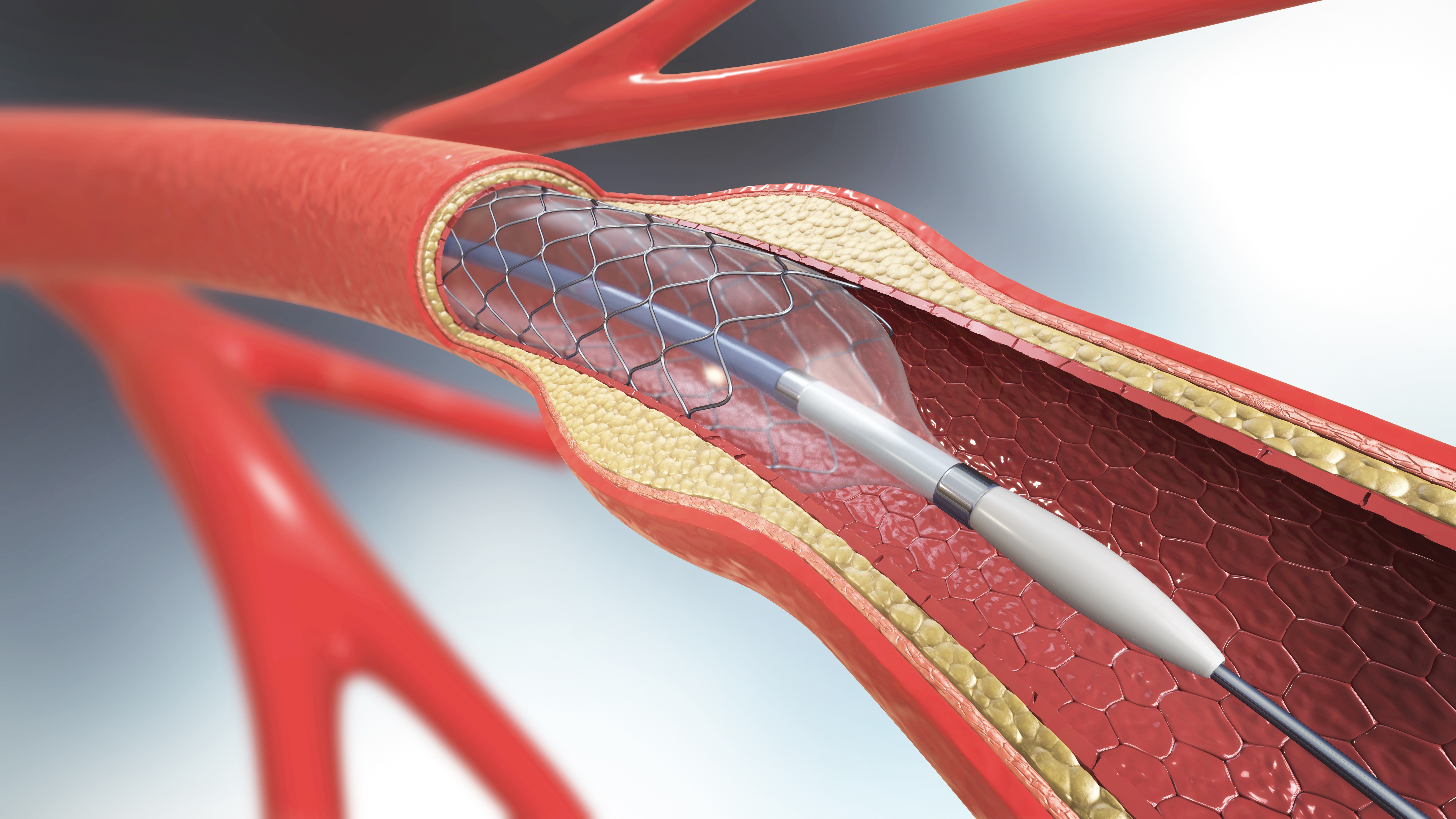
Coronary stent is a device in the form of a small metal tube used to treat narrowed or blocked areas in the coronary arteries that feed the heart muscle. These stents, which are generally supported by drug-releasing polymer coatings, prevent the vessels from narrowing again after balloon angioplasty. It is widely used to reduce the risk of heart attack and improve blood flow, especially in individuals with coronary artery disease. Stents are a critical treatment method that helps preserve heart health in the long term.
Short Answer: A stent is a small metal cage that is placed in the stenosis area in the heart vessel and keeps the vessel open. Most procedures are performed with local anesthesia, usually at the wrist. Rapid discharge is possible in suitable patients. Stent selection; It is personalized according to the vascular structure, patient’s clinical risk and intervention strategy.
Stent Types
The most commonly used stents in practice are drug-eluting (drug) stents. In addition, different polymer structures and technical options depending on the lesion type can be used in selected cases. Aim; is to keep the vein open and reduce the risk of narrowing again.
Stents generally consist of metal alloys specially developed for medical uses. The properties of these metal alloys may vary. The new generation of stents are made from thinner and rounded delicate metals. Most of the time, certain surfaces are coated with polymers and they contain drugs that prevent re-narrowing. These are called medication stents.
Why do I need a stent?
When the coronary vessels feeding the heart narrow, the heart that pumps blood to the body may have difficulty working. The heart muscle needs oxygen to function strongly, and oxygen reaches the heart muscle with the blood coming through these vessels. When the power of the heart decreases, the blood supply to the whole body will decrease and you will start to get tired quickly. When the heart is not adequately oxygenated, a feeling of breathlessness or tightness in the chest usually occurs during exertion.

If these stenoses are at a critical level, they need to be opened. Since drug therapy alone cannot open these stenoses, mechanical treatment is needed.
There are two ways to open the coronary vessels:
- Coronary stent or medicated balloon
- Bypass surgery With the
stent, most difficult vessels can be opened today without the need for surgery. “Would stent or bypass be more appropriate?”, the answer to this question is given according to the patient’s clinical condition and the results of some risk scores.
How is stent procedure done?
Stent procedure is performed with a special advancing system over a hair-thin wire advanced into the coronary vessel. The stent, placed by compressing on a balloon, is advanced to the coronary vessel where the stenosis is located and is implanted at the exact point where the stenosis is detected millimetrically on the monitors.
Nowadays, a stent procedure can usually be performed in the same session as angiography. Your doctor will inform you if proceeding is appropriate.
Let us explain the stent process step by step:
- A flexible catheter is advanced through the soft and thin sheath on your wrist or groin to your heart.
- A hair-thin guide wire is directed through this catheter to the problematic vein.
- This wire acts as a rail and guides the advancement system on which the stent is placed.
- The stent is positioned millimetrically at the point of stenosis on the monitors
- When it is determined that it is in the right place, the stent is inflated with the help of a balloon and placed into the vein by expanding it.
- Here, with the right pressure, the stent is ensured to completely contact the vessel wall. This is one of the most important steps of the process.
- Checks are made from different angles to confirm that the problematic vein is opened.
- All wires and catheters inside are taken out
- The sheath on the wrist or groin is removed and a bandage is applied
- The patient is taken to his room. ECG, blood pressure and pulse checks are performed
- Can eat and drink water immediately unless there is a special situation
- If it is made from the wrist, it can stand up immediately. If it is done from the groin, it may be necessary to lie down for 6-12 hours.
- After the checks are made in the morning of the next day, the patient is discharged with recommendations about medications and healthy living.
- A cardiology appointment is scheduled for one month later
Stent examples
The previously placed stent of a 63-year-old male patient was blocked and a new critical stenosis occurred in the main coronary artery. A new generation drug-eluting stent was placed in the main coronary artery of the patient, who previously had no choice but bypass surgery, and the blocked stent was opened with balloon angioplasty.
 Figure 1. Stenosis in the coronary artery before stent placement
 Figure 2. Stent placement
 Figure 3. Vascular opening after stent
Stent or bypass surgery?
When the coronary vessels feeding the heart are critically narrowed, there are 2 methods to open them:
- Stent
- By-pass surgery
A multifaceted evaluation is needed when making this decision. It is very important at this point to discuss your
Review the angiography images with an experienced interventional cardiologist. They will choose the most appropriate treatment by considering your clinical condition, coronary anatomy and the extent of coronary artery disease.
Results equivalent to bypass surgery can often be achieved with the new generation stents used today. In the past, the biggest advantage of bypass surgery was that it was less likely to narrow again in the coronary arteries. These results were in favor of bypass because stents were not developed at this level and stents that did not contain drugs were used. With the development of medicated stents in the early 2000s and the minimization of the possibility of re-stenosis with the 3rd generation stents today, stents have achieved results that are at least as successful as bypass.
To compare stent and bypass surgery in general terms, the stent opens the stenosis in the coronary artery. In other words, it is doing some kind of restoration. In bypass surgery, the narrowing remains as it is, and the veins going to the breast or leg are removed and sewn beyond the narrowed area to create backup pathways. However, studies show that the veins, especially those taken from the legs, can narrow and become blocked in a short time. Breast veins, on the other hand, are quite long-lasting and successful.
The biggest advantage of the stent procedure is that it can be performed from the wrist, the patient is awake throughout the procedure and can return to normal life the next day. In bypass surgery, the patient must stay in the hospital for at least 5 days, it is performed under general anesthesia and the recovery period lasts approximately 40-60 days.
There are some special scoring systems in making the decision. Interventional cardiologists can make calculations by looking at your [angiogram] film with a risk scoring program called the SYNTAX score. By-pass surgery may be a better option for those with a high SYNTAX score. However, if the patient has a high risk of surgery, stenting can still be performed despite the high SYNTAX score.
In controversial situations, cardiologists and cardiovascular surgeons can jointly decide on the best treatment option in meetings called heart councils.
My personal approach to coronary stent
Thanks to advances in coronary stent technology, the need for open bypass surgery is decreasing in many patients today. Current studies have shown that stent and bypass treatments can be applied with high success rates in appropriate patient groups.
In many patients I consulted after angiography, rapid recovery can be achieved with stent and balloon treatments, especially in cases that do not want bypass or have a high surgical risk. Entry through the wrist, local anesthesia and short recovery time significantly increase patient comfort.
In my own approach, I mostly perform stent procedures from the wrist. Thanks to special wires, microcatheters, medicated balloons and third generation medicated stents, it is possible to obtain effective results in many vascular lesions that were considered difficult to treat in the past.
What is a drug-eluting stent?
Stents used to open stenosis in coronary vessels can now be coated with drugs. These stents, which contain special drugs that prevent re-narrowing of the coronary vessels, are called drug-eluting stents. Drug coating could not be applied to the first stents. Studies have shown that these non-medicated stents often narrow. Thanks to new technologies, metal stents can be coated with drugs. In this way, re-stenosis rates have decreased very significantly. Today, there are drug-coated stents with fixed polymer, meltable polymer and polymer-free. Although there are no major differences in success between each other, stent technology continues to improve over time. Drug diversity is also increasing. However, when we look at the drug properties in general, more successful results are achieved with stents containing -limus group drugs (everolimus, zotarolimus, sirolimus, etc.).
Is treatment possible with a medicated balloon? Thanks to the developments in medicated balloon technology, it has
become possible to treat areas where stents were previously avoided. Currently, the most commonly used situations are the opening of new stenoses formed in previously placed stents. Additionally, experience and studies regarding its application to side veins and small veins are increasing. As technology advances, it will be possible to apply it to veins that were previously considered to be treated with stents.
How long does the stent procedure take?
In a coronary stent procedure, it takes approximately 30 minutes to place a stent in a vessel. In complex cases with high levels of difficulty, it may take up to 2 hours. Generally, stent procedure is performed in the same session as angioplasty. In rare cases, your doctor may recommend that it be performed in a different session than angiography.
Where is the stent procedure performed?
If your doctor started the procedure from the wrist, the stent procedure will usually continue through the wrist. If the angiography procedure started through the groin, it will continue through the groin. Switching access sites is rarely necessary.
Do I need to stay in the hospital after the stent procedure?
It is recommended that you stay in the hospital for one night after the stent procedure. Same-day discharge is not preferred very often, but some studies show that same-day discharge is safe when performed from the wrist.
How much blood thinner should be used after stent?
After drug-eluting stents, European and American guidelines recommend continuing dual blood thinners for at least 1 year.
It is emphasized that in new generation drug-eluting stents, dual blood thinner treatment may be sufficient for 1-3 months in selected patients. However, these findings have not yet been reflected in the guidelines and have not entered routine practice. Blood thinners are the most vital medications after stent and should never be stopped without consulting your doctor.
Blood thinners are drugs containing aspirin, clopidogrel, ticagrelor and prasugrel. The most commonly preferred combination is aspirin and clopidogrel. The most frequently preferred combination in acute cardiac events (myocardial infarction, etc.) is the combination of aspirin and ticagrelor. There may be cases where blood thinners are given for longer than 1 year. You should definitely discuss this issue with your doctor who follows you.
What are the risks of stents?
Some risks that may develop with stent procedure:
- Re-narrowing of the attempted vessel
- Clot formation
- Bleeding
Very rare risks:
- Heart attack
- Damage to the vein
- Kidney failure
- Stroke
The most effective and reliable method to open stenosis in coronary vessels is to place a stent. However, there are risks associated with existing heart disease and some risks of the procedure. Mostly, stent procedure is performed to reduce your current risk. This will increase your chances of recovery. But some complications, although rare, may develop during the procedure. The most effective way to prevent this is to have this procedure performed by an experienced interventional cardiologist in a well-equipped center.
Drug-eluting stents are used today to prevent the artery from narrowing again. Since re-stenosis is frequently observed in balloon-only cases, medicated stents have provided an effective solution to this problem.
The most common complication is observed at the entry site, as in angioplasty. Bleeding, bruising and swelling may be observed, especially in procedures performed in the groin. For this reason, procedures performed from the wrist are more advantageous. Because it is an area where bleeding can be controlled very easily. Before and during the stent procedure, intense blood thinners are given to prevent clot formation. This can cause uncontrolled bleeding in the groin area, where bleeding can occur relatively easily. When detected early, this bleeding can be stopped by applying pressure, but rarely, surgery may be needed.
Another complication is the ballooning of the artery in the groin and forming an aneurysm. This is called a pseudoaneurysm. Although there are non-surgical methods to close it, a surgical operation may be required if it does not close.
Clot formation during the procedure is another risk. However, today, when blood thinners are used in all procedures, this possibility has decreased considerably.
Rupture of the coronary artery is a complication that patients occasionally report. Especially the veins of older patients are quite delicate and fragile. Advanced calcification may also be seen in some patients. Rupture may occur in these vessels when treated with high pressure. Experienced cardiologists can see this possibility before the procedure and provide treatment with appropriate techniques. For example, a very chalky stenosis can be prepared for a balloon and stent by pre-treatment with a special shaving device called a rotablator, rather than a high-pressure balloon. In this way, the risk of tearing is minimized. A fully equipped laboratory has special stents to close the tear. Although it can usually be resolved without surgery, surgery may occasionally be needed.
A heart attack may occur if a clot or piece breaks off from the treated plate during the procedure. For this reason, blood thinners are given intensively during the procedure and this possibility is reduced.
Kidney failure is a rare complication. Minimal administration of contrast material during the procedure and fluid intake before and after the procedure reduce the possibility of this complication.
How long should I fast before the stent procedure?
New studies support keeping hunger and thirst duration to a minimum. Today, since the procedures are performed with local anesthesia, 2 hours of fasting is sufficient. However, if general anesthesia is planned, you will be asked to fast for a longer time.
Will I sleep during the stent procedure?
Stent procedure is performed with local anesthesia. You can often stay awake during the procedure by chatting with your doctor. However, if your excitement level is high, you may want a medicine that will induce light sleep.
How much blood thinner should I use after stent procedure?
After the stent procedure, two blood thinners are usually given for 1 year. One of these is aspirin and the other is a special blood thinner (clopidogrel, ticagrelor or prasugrel). Blood thinner treatment is the most vital treatment after stent. If it is cut early, it may cause a clot to form inside the stent, resulting in a life-threatening heart attack. You should never stop your blood thinners without asking your doctor. Inform your doctor about this situation before tooth extraction or surgery.
Since the risk of bleeding is high in some patients, the number of blood thinners may be reduced to one after a while. If there is no risk of bleeding, one blood thinner will be discontinued at the end of 12 months, and one blood thinner will continue for life.
Would drug therapy be sufficient instead of stent?
If there is 70% or more stenosis in the coronary artery, the blood supply to this area will mechanically decrease. The heart muscle needs blood and oxygen. Unfortunately, medication will not open these stenoses. In non-critical stenosis, the best treatment is medication. It will slow down the growth of existing plaques and reduce the risk of clots forming on them.
Is making a balloon instead of a stent sufficient?
Balloon angioplasty is part of the stent procedure. Before placing the stent, the vessel is expanded with a balloon. The stent is placed on a balloon. This balloon is inflated and the stent is placed in the vein. In addition, after the stent is placed, harder balloons are sometimes used to ensure better opening of the stent.
Treatment can only be done with a balloon, but restenosis is more common. In cases of re-stenosis occurring within previously placed stents, sometimes treatment is only possible with a balloon. A balloon alone can also be considered in thin vessels. Medicated balloons provide more successful results than plain balloons.
How many stents can be placed in the coronary vessels?
There is no limitation on the number of stents that can be placed in coronary vessels. Sometimes, in very complex cases, all coronary vessels can be opened in 2 separate sessions. In order to keep the number of stents to be placed at a minimum, it may be considered to detect non-critical stenosis and treat small vessels with a medicated balloon. There are many patients who have had 10 or more stents inserted. However, if many stents need to be placed, bypass surgery should also be considered. Even if it is decided to insert a stent, it may be less tiring for the patient if it is done in two separate sessions instead of a single session.
What is a dissolvable stent?
They are drug-coated, dissolvable stents developed to open the stenosis in the coronary artery. They are mostly made of meltable polymer and are not metal. There are also dissolvable stents made of magnesium. However, today these dissolvable stents are no longer produced. Research on new generation dissolvable stents continues.
What is hybrid therapy?
Treating a patient’s coronary artery stenosis by performing both stent and bypass surgery is called hybrid treatment. Especially in patients with 3 or more vessel diseases and in whom it is difficult to open the chest, the mammary vein is connected to the vein feeding the anterior wall, called LAD, with robotic surgery, and stents are placed in other vessels in a separate session. In this way, multiple benefits can be provided to the patient. Although it is not a method that is needed very often, it is a good alternative to open heart surgery.
How does the stent price vary?
Stent price cannot be standardized with a single figure. Price; It varies depending on the complexity of the stenosis, the stent technology used (e.g. drug-eluting stent type), the need for additional devices during the procedure, and the center infrastructure.
Additionally, intervention in more than one vein in the same session or the need for additional intervention also affects the total cost. Therefore, exact price information is given after the angiographic and clinical evaluation of the patient.
How should the doctor and center be chosen for stent?
A healthier approach than searching for “best” is to decide with objective criteria:
- Interventional cardiology experience and complex case experience,
- 24/7 emergency response and complication management capacity of the center,
- Currentness of the technologies used (IVUS, OCT, calcification treatments, etc.),
- Pre-procedural information quality and patient communication,
- Clarity of post-procedure follow-up plan.
Choosing the right team and the right center determines not only technical success, but also long-term safety and quality of life.
Frequently Asked Questions
What is a coronary stent? A coronary stent is a small metal tube placed to keep narrowed coronary arteries open.
How is stent procedure done? After balloon angioplasty, the stent is advanced and placed in the stenosis area in the vessel.
Stent or bypass? Selection; It is done according to the vascular structure, the risk of the patient and the clinical situation.
How long does the process take? It usually takes a short time, although it varies depending on the complexity of the case.
Will I stay in the hospital after stent? An overnight stay is generally recommended; Discharge on the same day is also possible in suitable patients.
How much medication is used after stent? Blood thinners are used for a certain period of time according to the doctor’s recommendation.
How does the stent price vary? Stent price; The scope of the procedure varies depending on the stent technology used, the need for additional intervention and center conditions.
What should I pay attention to when choosing a doctor and center for stent? Interventional cardiology experience, center infrastructure, complication management, information quality and follow-up plan should be evaluated together.
What is a medicated balloon and in which patients is it preferred? Medicated balloon; It is a treatment option that can be evaluated without placing a new stent, especially in cases of in-stent restenosis and selected small vessel lesions.